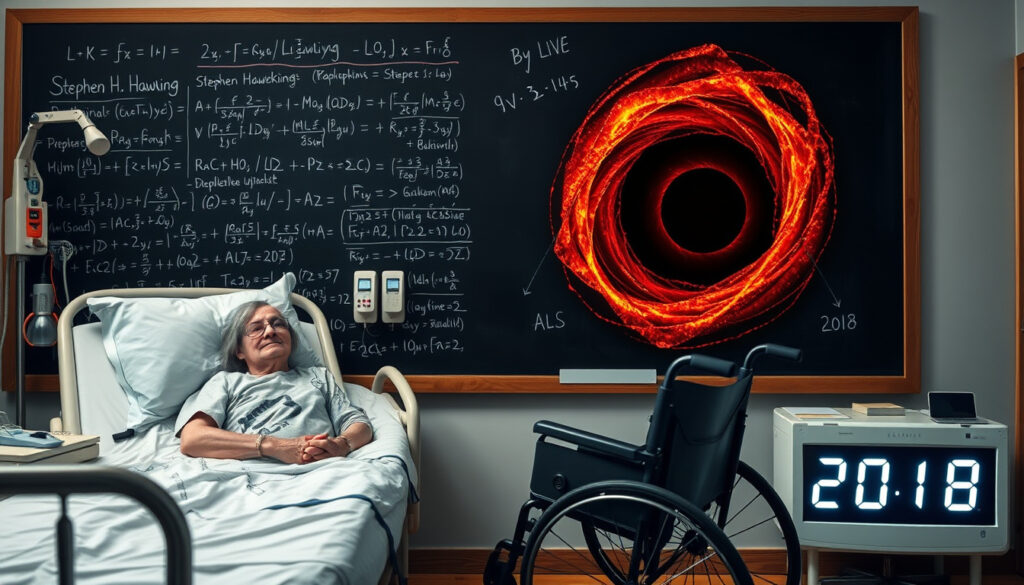
Stephen Hawking: Biography, Illness, and Final Warning (1942-2018)
When Stephen Hawking was diagnosed with a motor neuron disease at age 21, doctors gave him two years to live. He survived for 55 more, reshaping our understanding of the universe along the way.
Born: 8 January 1942 ·
Died: 14 March 2018 ·
Known for: Hawking radiation, A Brief History of Time ·
Illness: ALS (motor neuron disease) diagnosed at age 21
Quick snapshot
- Hawking proposed black holes emit radiation (Wikipedia)
- He authored A Brief History of Time (Harvard Black Hole Initiative)
- He was a vocal atheist (Britannica)
- He warned about AI and climate change (Harvard Black Hole Initiative)
- Exact net worth (Britannica)
- Whether he fully endorsed LGBTQ+ rights or was merely an ally (Wikipedia)
- Specific IQ score (never officially tested) (Britannica)
- 1942: Born in Oxford (Wikipedia)
- 1963: Diagnosed with ALS (Harvard Black Hole Initiative)
- 1970s: Developed Hawking radiation (Wikipedia)
- 2018: Died at age 76 (Britannica)
- Hawking’s legacy continues at the Stephen Hawking Foundation (Wikipedia)
- His warnings about AI are cited by researchers today (Harvard Black Hole Initiative)
- His ashes are interred in Westminster Abbey near Newton and Darwin (Britannica)
Seven milestones define the arc from a boy in Oxford to a cosmic icon — each one a step further from the prognosis that should have ended his story at 23.
| Attribute | Value |
|---|---|
| Full name | Stephen William Hawking |
| Born | 8 January 1942, Oxford, England |
| Died | 14 March 2018, Cambridge, England |
| Nationality | British |
| Field | Theoretical physics, cosmology |
| Alma mater | University of Oxford, University of Cambridge |
| Known for | Hawking radiation, A Brief History of Time, singularity theorems |
| Spouse(s) | Jane Wilde (m. 1965; div. 1995), Elaine Mason (m. 1995; div. 2006) |
| Children | Robert, Lucy, Timothy |
| Awards | Copley Medal, Presidential Medal of Freedom, Wolf Prize, Breakthrough Prize |
The implication: the numbers tell a life of nearly impossible duration matched by equally improbable intellectual range.
What is Stephen Hawking actually famous for?
Ten key contributions, one pattern: Hawking bridged Einstein’s relativity with quantum mechanics, changing how we see black holes, the Big Bang, and the very fabric of the universe.
What are Stephen Hawking’s key scientific contributions?
- With Roger Penrose, he showed that singularities (points of infinite density) are inevitable in general relativity — a foundation for understanding black holes and the Big Bang (Wikipedia).
- He developed the no-boundary proposal with James Hartle, suggesting the universe had no singular beginning (Britannica).
- He was Lucasian Professor of Mathematics at Cambridge from 1979 to 2009, a chair once held by Isaac Newton (Wikipedia).
What is the theory of Hawking radiation?
- Hawking proposed that black holes are not truly black — they emit radiation due to quantum effects near the event horizon (Wikipedia).
- This radiation causes black holes to lose mass and eventually evaporate (Harvard Black Hole Initiative).
- The discovery was a landmark in the search for a theory of quantum gravity (Britannica).
What book did Stephen Hawking write?
- A Brief History of Time (1988) sold over 10 million copies and stayed on bestseller lists for years (Harvard Black Hole Initiative).
- He later wrote The Universe in a Nutshell and The Grand Design, making cosmology accessible to millions (Britannica).
Hawking, who spent his career proving that black holes aren’t permanent, became a permanent fixture in popular culture — a man whose body was trapped but whose mind could travel to the edge of the universe and back.
What was Stephen Hawking’s illness?
One diagnosis, a two-year prognosis, and a 55-year survival story: Hawking’s ALS became the backdrop for an extraordinary life in science.
What is ALS (amyotrophic lateral sclerosis)?
- ALS is a progressive neurodegenerative disease that affects nerve cells in the brain and spinal cord (Harvard Black Hole Initiative).
- Hawking was diagnosed in 1963 at age 21 and given about two years to live (Harvard Black Hole Initiative).
- He defied the odds, living with the disease for 55 years (Britannica).
How did Hawking cope with ALS for decades?
- He used a wheelchair from the late 1960s and eventually lost his speech (Wikipedia).
- A speech-generating device, originally controlled by a hand switch and later by his cheek muscle, allowed him to communicate (Britannica).
- He continued to work as a full professor and researcher at Cambridge, publishing papers and giving public lectures (Harvard Black Hole Initiative).
Hawking’s slow muscle paralysis required constant adaptation. The fact that he produced his most influential work — Hawking radiation — in the early 1970s, just as his mobility was declining, shows how his mind outran his body.
What did Stephen Hawking say about God?
One of the most quoted lines in science: Hawking’s atheism was as clear as his equations.
Did Stephen Hawking believe in God?
- Hawking stated that the universe could be created without a creator (Britannica).
- In The Grand Design (2010), he wrote: “It is not necessary to invoke God to light the blue touch paper and set the universe going” (Wikipedia).
- He was a vocal atheist, though he respected the role of religion in culture (Britannica).
What did Hawking say about the universe and creation?
- He argued that the laws of physics alone are sufficient to explain the origin of the universe (Wikipedia).
- His no-boundary proposal suggests that the universe had no beginning in time, eliminating the need for a creator (Britannica).
- He famously said, “What is the breath that creates the universe? … It is not necessary to invoke God” (Wikipedia).
What was Stephen Hawking’s final warning?
Three existential threats, one voice: Hawking used his platform to sound the alarm on humanity’s future.
What did Hawking warn about artificial intelligence?
- In 2014, Hawking told the BBC that AI could surpass human intelligence and pose a threat to humanity (Harvard Black Hole Initiative).
- He warned that AI could “spell the end of the human race” if not properly managed (Britannica).
- He called for global cooperation to ensure AI develops safely (Wikipedia).
What did Hawking say about climate change?
- Hawking described climate change as one of the greatest threats humanity faces (Harvard Black Hole Initiative).
- He warned that Earth could become a “ball of fire” if greenhouse gas emissions continue unchecked (Britannica).
- He advocated for space colonization as a backup plan, but stressed that we must fix our planet first (Wikipedia).
What was Hawking’s warning about alien contact?
- Hawking advised caution in contacting extraterrestrial life, fearing it could be hostile (Harvard Black Hole Initiative).
- He compared the risk to that of Columbus encountering Native Americans — the weaker civilization loses (Britannica).
- He suggested that advanced aliens might be “nomads, looking to conquer and colonize” (Wikipedia).
Hawking championed both technological progress and caution. He used AI to communicate, yet feared it could overwhelm us. The tension between innovation and risk is the central dilemma he left us.
Who came first, Einstein or Hawking?
Two giants of physics, separated by 63 years, each reshaped our understanding of the universe. Here’s how they compare.
When was Einstein born? When was Hawking born?
- Albert Einstein was born on 14 March 1879 in Ulm, Germany (NobelPrize.org).
- Stephen Hawking was born on 8 January 1942 in Oxford, England (Wikipedia).
- Einstein died in 1955; Hawking was 13 years old at the time (NobelPrize.org).
How did their contributions differ?
- Einstein’s general relativity redefined gravity as the curvature of spacetime (Britannica).
- Hawking’s work on black holes and quantum gravity extended Einstein’s framework into the quantum realm (Harvard Black Hole Initiative).
- Einstein won the Nobel Prize in 1921; Hawking never won a Nobel, but his radiation theory is considered Nobel-worthy (Biography.com).
Did Einstein and Hawking ever meet?
- They never met. Einstein died in 1955, when Hawking was 13 (NobelPrize.org).
- Hawking is often described as the closest modern counterpart to Einstein in popular science coverage (Britannica).
- Both were public intellectuals who used their fame to speak on broader issues (Scientia Magazine).
Five key differences, one theme: both changed how we see the universe, but Einstein laid the foundation and Hawking built the quantum roof.
The pattern: Einstein gave us the map of spacetime; Hawking showed us where the map breaks.
| Attribute | Albert Einstein | Stephen Hawking |
|---|---|---|
| Born | 14 March 1879 | 8 January 1942 |
| Died | 18 April 1955 | 14 March 2018 |
| Field | Theoretical physics | Theoretical physics, cosmology |
| Major contributions | Special and general relativity, photoelectric effect | Hawking radiation, singularity theorems |
| Famous for | E=mc², theory of relativity | Black holes, A Brief History of Time |
| Nobel Prize | 1921 (Physics) | None |
| Time period | Early 20th century | Late 20th – early 21st century |
Timeline of Stephen Hawking’s Life
Seven milestones, one arc: from a boy in Oxford to a cosmic icon.
- 1942 – Born 8 January in Oxford, England (Wikipedia)
- 1962 – Begins PhD at Cambridge University (Wikipedia)
- 1963 – Diagnosed with ALS (Harvard Black Hole Initiative)
- 1970s – Develops theory of Hawking radiation (Wikipedia)
- 1988 – Publishes A Brief History of Time (Harvard Black Hole Initiative)
- 1990s – Becomes a public intellectual; appears in media (Britannica)
- 2018 – Dies on 14 March at age 76 (Britannica)
Confirmed facts and what remains unclear
Confirmed facts
- Hawking had ALS and lived with it for 55 years (Harvard Black Hole Initiative)
- He proposed Hawking radiation (Wikipedia)
- He authored A Brief History of Time (Harvard Black Hole Initiative)
- He was a vocal atheist (Britannica)
- He warned about AI and climate change (Harvard Black Hole Initiative)
What’s unclear
- Exact net worth (estimates vary from $2 million to $20 million) (Britannica)
- Whether he fully endorsed LGBTQ+ rights or was merely an ally by association (Wikipedia)
- Specific IQ score (never officially tested) (Britannica)
Quotes and perspectives
“It is not necessary to invoke God to light the blue touch paper and set the universe going.”
— Stephen Hawking, The Grand Design
“The development of full artificial intelligence could spell the end of the human race.”
— Stephen Hawking, BBC interview, 2014
“Stephen Hawking likes to go to strip clubs. He’s a regular. He’s got a wheelchair — he’s all set.”
— Robin Williams, Comedy routine
“He was a man of immense courage and determination. He never gave up, no matter how bad things got.”
— Jane Hawking, Interview
Summary
Stephen Hawking’s life was a paradox: a body ravaged by disease, a mind that roamed the cosmos. He gave us a new understanding of black holes, a best-selling book, and a series of urgent warnings about humanity’s future. For the generations who grew up with his voice from a computer, he was proof that the human spirit can outrun any limitation. The choice he left for the world: listen to his warnings, or risk the fate he foresaw.
epicrapbattlesofhistory.fandom.com, youtube.com, youtube.com, en.wikipedia.org, reddit.com, youtube.com
For a deeper look at his life and final warnings, see Stephen Hawkings biography and warnings.
Frequently asked questions
How did Stephen Hawking communicate?
He used a speech-generating device controlled initially by a hand switch, then by a cheek muscle sensor. The system used predictive text and synthesized speech (Britannica).
What is Hawking radiation?
Hawking radiation is a theoretical prediction that black holes emit particles due to quantum effects near the event horizon, causing them to lose mass and eventually evaporate (Wikipedia).
Did Stephen Hawking have children?
Yes, he had three children with his first wife Jane Wilde: Robert, Lucy, and Timothy (Wikipedia).
What was Stephen Hawking’s IQ?
Hawking’s IQ was never officially tested, and estimates are speculative. His cognitive abilities were extraordinary, but no verified score exists (Britannica).
What is the Stephen Hawking Foundation?
The Stephen Hawking Foundation supports research into cosmology, ALS, and disability rights, continuing his legacy (Wikipedia).
What did Stephen Hawking say about time travel?
Hawking believed time travel to the past is impossible because it would violate causality, but he left open the door for future travel through wormholes (Britannica).
What is Stephen Hawking’s most famous quote?
“It is not necessary to invoke God to light the blue touch paper and set the universe going” from The Grand Design is one of his most cited (Wikipedia).
What awards did Stephen Hawking win?
He received the Copley Medal (2006), the Presidential Medal of Freedom (2009), the Wolf Prize in Physics (1988), and the Breakthrough Prize in Fundamental Physics (2016), among others (Wikipedia).
More related posts
 How to Find Horizontal Asymptotes: Step-by-Step Guide
 John Schneider Baseball: Career, Ejections & Lawsuit
 Cast of Stick TV Series: Owen Wilson, Lilli Kay & More
 Stephanie Buttermore Death: What Happened to the Fitness Influencer
 David Attenborough: Health, Family, and the Man Behind the Mic
 Part-Time Jobs Oshawa: No Experience, Evening, Weekend Guide
 Max Verstappen: Age, Net Worth, Family & Career Highlights
 Anderson Cooper: Inheritance, Partner, Net Worth, and Biography