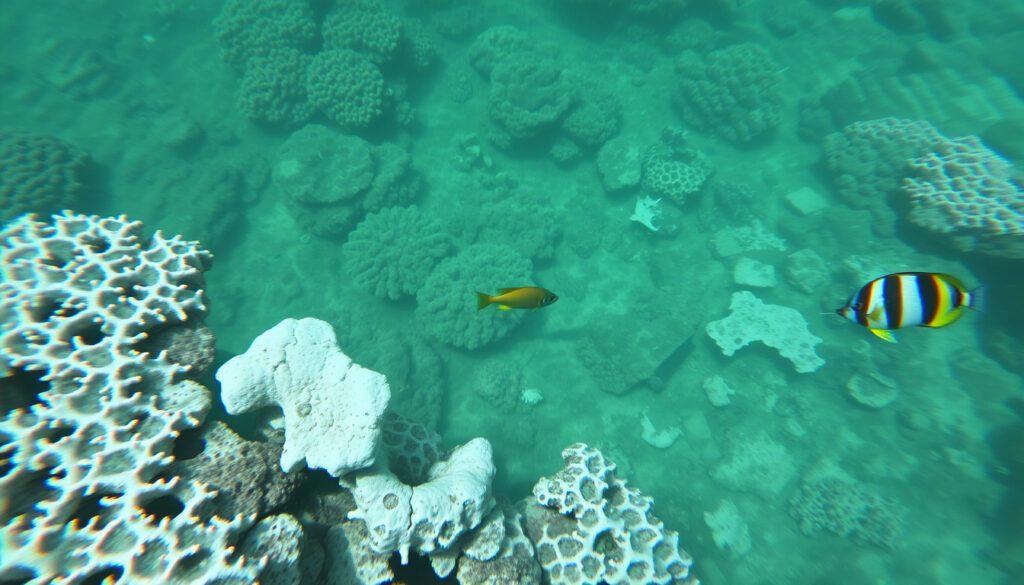
Coral Reef Types, Locations, and Future: Are They Gone by 2050
If you picture coral reefs, your mind probably jumps to crystal-clear tropical waters. But off the west coast of Ireland, at depths of 300–500 metres, cold-water coral reefs thrive in near darkness.
Known types of coral reefs: 4 (fringing, barrier, atoll, platform) ·
Largest coral reef system: Great Barrier Reef (Australia) – over 2,300 km ·
Estimated global coral cover lost since 1950: 50% ·
Cold-water corals in Ireland: Confirmed in deep-sea carbonate mounds up to 500 m depth ·
Projected year for near-total tropical reef collapse: 2050 (under high-emissions scenarios)
This article looks at the four main types of coral reefs, the world’s largest reef systems, the surprising deep-water coral communities in Irish waters, and what the science says about their future by 2050.
Quick snapshot
- Four main reef types: fringing, barrier, atoll, platform (Ask About Ireland)
- Ireland hosts deep-water cold-water coral reefs at 300–500 m depth (Ask About Ireland cold-water resource)
- Exact year of total collapse depends on emission reductions
- Whether cold-water corals in Ireland will warm at the same rate as tropical reefs
- Total economic losses from reef degradation by 2050 remain difficult to model
- Global coral cover decline of 50% since 1950 – exact figure varies by region and methodology
- 1998: First major global coral bleaching event (NOAA)
- 2016–2017: Second major bleaching; Great Barrier Reef severely affected (Great Barrier Reef Foundation)
- 2019–2020: Irish Marine Institute reports cold-water reef changes at 20% over 4 years (Marine Institute)
- Up to 90% of tropical reefs at risk by 2050 under high emissions (IPCC)
- Irish cold-water reefs face new pressures from ocean acidification and bottom trawling (University College Cork)
- Whether conservation efforts and emission cuts will be sufficient to improve survival odds remains unclear (IPCC)
Five key facts about coral reefs, from global extent to the depth of Irish cold-water communities:
| Fact | Value |
|---|---|
| Total global reef area | Approximately 284,000 square kilometres |
| Number of reef-building coral species | Around 800 |
| Largest reef system | Great Barrier Reef, Australia (2,300+ km) |
| Irish cold-water reef depth range | 300–500 metres |
| Projected decline by 2050 (high emissions) | 90% of tropical reefs threatened |
| Main cold-water coral species in Ireland | Lophelia pertusa and Madrepora oculata (National Parks & Wildlife Service) |
| Estimated economic value of coral reefs | $375 billion per year (global estimate) |
| Percentage of marine species supported | 25% (WWF) |
What are the 4 types of coral reefs?
Coral reefs fall into four structural categories, each defined by its relationship to land and shape. Scientists have recognised these types since the 19th century, following Charles Darwin’s original classification.
Fringing reefs
- Grow directly from the shoreline, with no significant lagoon.
- Common in the Caribbean and Red Sea (Ask About Ireland educational resource).
- Often the first stage of reef development.
Barrier reefs
- Separated from the shore by a deep, navigable lagoon.
- The Great Barrier Reef is the largest example, stretching over 2,300 km along Australia’s coast (Great Barrier Reef Foundation).
- Found along continental margins and around some islands.
Atolls
- Ring-shaped reefs enclosing a central lagoon.
- Form on top of submerged volcanic islands that have sunk below sea level.
- Typical in the Pacific and Indian Oceans (Lophelia.org).
Platform reefs
- Isolated, flat-topped structures on continental shelves.
- Also called patch reefs.
- Less extensive than barrier reefs but still biologically rich.
The pattern: each reef type demands a tailored conservation approach, making classification a practical tool for marine management.
Where are the top 3 largest coral reefs in the world?
Three reef systems stand out for their sheer scale. The order is based on continuous length of barrier reef structure.
Great Barrier Reef (Australia)
- Length: over 2,300 km.
- Area: approximately 344,400 square kilometres (Great Barrier Reef Foundation).
- Contains more than 2,900 individual reef systems.
Mesoamerican Barrier Reef (Central America)
- Length: over 1,000 km.
- Runs from the Yucatán Peninsula (Mexico) down to Honduras (WWF).
- Second largest barrier reef system globally.
New Caledonia Barrier Reef (Pacific)
- Length: about 1,500 km.
- Encloses the second largest lagoon in the world.
- Rich in biodiversity, with many endemic species (UNESCO World Heritage Centre).
The three largest reefs are all tropical and all vulnerable to warming. Their size amplifies the stake: losing the Great Barrier Reef would affect Australia’s tourism, fisheries, and shoreline protection — a $6 billion annual economic impact, according to the Australian Department of Climate Change.
What this means: the scale of these reefs makes them both a global treasure and a high-risk asset, with economic and ecological consequences that extend far beyond their borders.
Are there any coral reefs in Ireland?
Yes — but they are not the sunlit, colourful reefs you see in documentaries. Ireland’s coral reefs are deep-water cold-water reefs, found in the dark, cold depths of the Atlantic.
Cold-water coral reefs in Irish waters
- Dominant species: Lophelia pertusa and Madrepora oculata (University College Cork repository).
- Water temperature range: 4–8°C.
- Depth range: 200–1,600 metres.
Location: Porcupine Bank, Rockall Trough
- Major reef provinces on the continental slope west of Ireland (CORDIS / EU Research).
- Carbonate mounds rise 300–500 metres above the seafloor, providing substrate for corals.
- A deep-water coral province was formally described in 2009 after high-resolution bathymetry mapping.
Species: Lophelia pertusa
- This stony coral builds the framework of Irish cold-water reefs.
- It does not rely on sunlight; it filters food particles from the water.
- Protected under the EU Habitats Directive, with Special Areas of Conservation designated (National Parks & Wildlife Service).
Cold-water corals thrive in conditions that would kill tropical reefs — cold, dark, high-pressure — yet they face the same ultimate threat: ocean acidification. The University of Edinburgh Research Explorer notes that acidification will reduce habitat quality for these deep-water ecosystems, even as surface waters warm.
The implication: Irish cold-water reefs are not a safe haven; they are a different battlefield in the same climate war.
Will coral reefs be gone by 2050?
This is the most urgent question facing coral science. The answer depends on greenhouse gas emissions, local conservation efforts, and the resilience of different reef types.
IPCC high-emission scenario projections
- Under RCP8.5 (high emissions), up to 90% of tropical coral reefs may be at risk by 2050 (IPCC Special Report on the Ocean and Cryosphere).
- Even under moderate scenarios, 70–90% of reefs could experience severe bleaching annually by 2050.
Coral bleaching and ocean acidification
- Rising sea temperatures cause corals to expel symbiotic algae, leading to bleaching and often death.
- Ocean acidification reduces the availability of carbonate ions, slowing coral growth (NOAA (U.S. National Oceanic and Atmospheric Administration)).
- Cold-water corals are also affected: the Marine Institute Ireland reported that Irish deep-water reefs changed at a rate of approximately 20% over four years.
Localized resilience and conservation
- Marine protected areas and reduced local stressors can improve survival odds.
- Cold-water corals in Ireland may face different threat profiles — warming is slower, but acidification penetrates deeper.
- The Frontiers in Marine Science study shows that cold-water corals on the Irish margin have only proliferated during warm interglacial periods over the last 300,000 years, suggesting some inherent resilience.
The catch: resilience is not immunity; without emission cuts, even the most robust cold-water reefs will eventually succumb.
What is a coral reef ecosystem?
Beyond the reef structure itself, the ecosystem supports a staggering web of life.
Coral reef habitat and animals
- Coral reefs cover less than 1% of the ocean floor but host 25% of all marine species (FAO).
- Animals include fish, crustaceans, molluscs, sea turtles, and sharks.
- Cold-water reefs have their own fauna: sponges, sea fans, and deep-sea fish.
Coral reef food web
- Primary producers: algae (zooxanthellae in corals, plus phytoplankton).
- Herbivores: parrotfish, surgeonfish, sea urchins.
- Predators: groupers, barracudas, sharks.
Importance of biodiversity
- Fisheries: about 500 million people depend on reef fish for protein (FAO).
- Coastal protection: reefs reduce wave energy by up to 97%.
- Economic value: estimated $375 billion per year globally from tourism, fisheries, and storm protection.
Protecting coral reefs means limiting coastal development and fishing pressure. For Ireland, the choice is between expanding deep-sea trawling operations (which damage cold-water coral mounds) and expanding the network of Special Areas of Conservation. The Lophelia.org resource notes that the Irish Government has taken steps to designate offshore SACs, but enforcement remains patchy.
The pattern: the same economic pressures that drive reef degradation also create the political will for conservation, but only when the trade-offs are made explicit.
Timeline
Key events in the history of coral reefs and their decline:
- 1950s: Global coral cover begins to decline due to human impacts.
- 1998: First major global coral bleaching event driven by El Niño (NOAA).
- 2003: Irish Government announces intention to designate offshore cold-water coral SACs (Lophelia.org).
- 2016–2017: Second major global bleaching event; Great Barrier Reef severely affected (NOAA).
- 2019–2020: Irish Marine Institute reports cold-water reef changes at 20% over 4 years (Marine Institute).
- 2050 (projected): Up to 90% of tropical coral reefs may be lost under high-emission scenarios.
The takeaway: the timeline shows that the window for action is narrowing, with each decade bringing more severe and frequent bleaching events.
Clarity breakdown
Confirmed facts
- Coral reefs are made of colonial polyps and calcium carbonate (Ask About Ireland).
- There are four main types of coral reefs (Ask About Ireland).
- Ireland has deep-water cold-water coral reefs at 300–500 m depth (National Parks & Wildlife Service).
- Coral reefs support 25% of marine biodiversity (WWF).
What’s unclear
- Exact year of potential total collapse depends on emission reductions.
- Whether cold-water corals in Ireland will warm at the same rate as tropical corals.
- Total economic losses from reef degradation by 2050 remain difficult to model.
- The long-term survival of cold-water corals in Ireland under ocean acidification is uncertain.
Expert perspectives
Irish deep-water coral reefs are changing faster than previously thought. We observed a 20% change in the condition of cold-water coral reefs over a four-year period.
— Marine Institute Ireland, press release
Under the highest emissions scenario, up to 90% of tropical coral reefs could be at risk of severe degradation by 2050. The window for action is closing rapidly.
— NOAA (U.S. National Oceanic and Atmospheric Administration), climate projections
For Ireland and Europe, the future of both tropical and cold-water reefs hinges on the rate of emission reductions. Without deep cuts, the cold-water corals of the Porcupine Bank will face acidification and bottom-fishing pressure — a double threat that the University College Cork repository warns could reduce habitat quality. The message from the science is consistent: protect what remains, and cut emissions to give reefs a fighting chance.
infomar.ie, universitytimes.ie, transceltic.com, academic.oup.com
For a detailed breakdown of the four main types of coral reefs, see our guide on types of coral reefs.
Frequently asked questions
What causes coral bleaching?
When water temperatures rise above normal, corals expel the symbiotic algae living in their tissues. Without the algae, the coral turns white (bleaches) and if conditions don’t return, it can die. The NOAA identifies prolonged heat stress as the primary trigger.
How do coral reefs form?
Reefs form when coral polyps secrete calcium carbonate skeletons that build up over thousands of years. The structure is then colonised by more corals and other organisms. Cold-water reefs form similarly, but without the symbiotic algae, relying on filter feeding.
What is the difference between warm-water and cold-water coral reefs?
Warm-water reefs require sunlight, clear water, and temperatures above 20°C. Cold-water reefs thrive in deep, dark waters at 4–8°C, using currents to bring food. They are built by different coral species, such as Lophelia pertusa in Ireland.
Can coral reefs recover after bleaching?
Yes, if the stress event is short-lived and the reef is healthy. Recovery can take decades. Repeated bleaching, however, can prevent recovery. The Great Barrier Reef Foundation notes that some reefs have shown partial recovery after the 2016 event.
What are the main threats to coral reefs?
Climate change (warming, acidification), overfishing, pollution, coastal development, and bottom trawling. For Irish cold-water reefs, bottom trawling and ocean acidification are the top concerns (University College Cork).
How long do coral reefs take to grow?
Slowly. Tropical corals grow at 1–10 cm per year. Cold-water corals grow even slower, often less than 1 cm per year. Because of this, damaged reefs can take centuries to recover.
What role do coral reefs play in coastal protection?
Reefs act as natural barriers, reducing wave energy by up to 97% and preventing coastal erosion. The WWF estimates that losing reefs would expose millions of people to increased storm damage.
More related posts
 Ruth Gemmell: Biography, Age, Partner & Career Highlights
 Luke Wilson Biography: First Child at 54 in 2026 and Family
 L’amour est dans le pré – History, Format and 2024 Season
 Lisa Kudrow: Biography, Net Worth, and Friends Legacy
 Best Sault Ste Marie Hotels: Prices & Amenities Compared
 Montreal Apartments for Rent – Cheap Student Housing Guide
 Robb Stark: Death, Last Words, and the Red Wedding Explained
 Phillip Danault: Biography, Career Stats, and Family