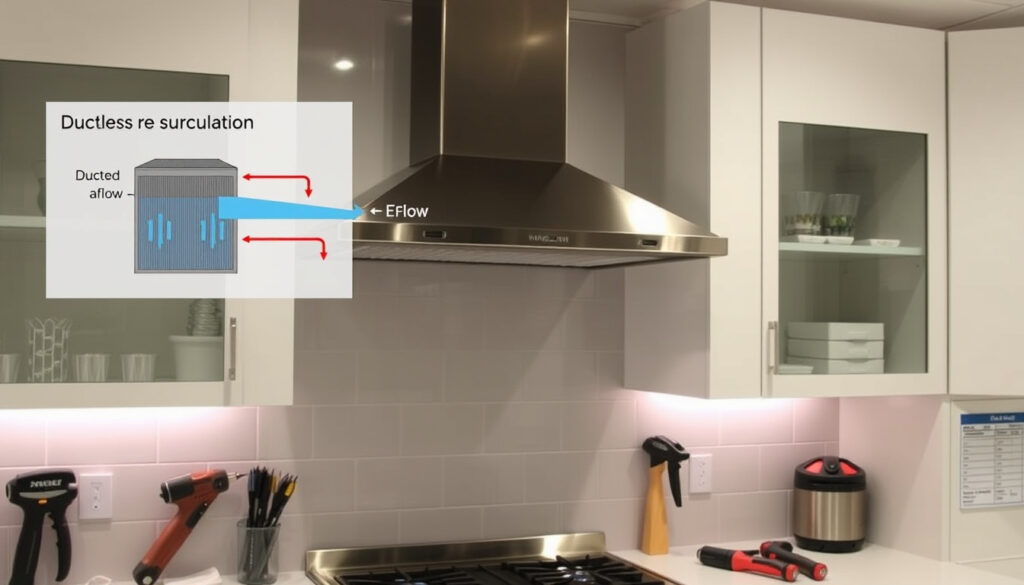
Range Hood Buying Guide: Ducted vs Ductless, Cost & Installation
If you’ve ever seared a steak and watched your kitchen fill with smoke, you know the value of a good range hood. The choice between a ducted unit and a ductless model affects your home’s air quality, energy efficiency, and local building code compliance.
Average range hood cost (installed): $350 – $1,200 · Minimum CFM recommended by code: 100 CFM per linear foot of cooktop · Ducted vs. ductless efficiency difference: Ducted removes 100% of airborne grease; ductless recirculates with charcoal filter · Typical noise level in sones: 3 – 7 sones · Most common duct size: 6 inches round · Percentage of new builds requiring hard‑ducted hoods: Nearly 100% under IRC M1503.1
Quick snapshot
- Vents all smoke, steam, and odors outside, as explained by KitchenAid (appliance manufacturer).
- Required by many building codes for new kitchens, per FOTILE (range hood brand).
- More effective at removing heat and moisture, according to the U.S. Department of Energy (DOE) guidance.
- Higher upfront installation cost due to ductwork — typically $500 extra, reports Angi (home services platform).
- Uses charcoal filters to clean air before recirculating, says KitchenAid.
- Suitable for apartments or kitchens without external access, per FOTILE.
- Lower installation cost — no ductwork needed; Homewyse (cost estimator) puts basic install between $564–$1,030.
- Less effective at removing moisture and heat, notes KitchenAid.
- CFM (cubic feet per minute) — aim for 400–600 CFM, per Lowe’s (home improvement retailer).
- Noise measured in sones — under 6 sones recommended, based on FOTILE guidance.
- Filter type: mesh (reusable) vs. charcoal (replaceable every 3–6 months), as noted by ProLine Range Hoods.
- Size: match to cooktop width plus 3–6 inches extra; common duct is 6‑inch round, reports Homewyse.
- Electrical: hardwired or plug‑in; may require an electrician, says Lowe’s.
- Duct material: rigid metal preferred over flexible, per FOTILE.
- Duct length: keep under 30 linear feet for efficiency; each 90° elbow reduces CFM by ~5 ft of straight duct, warns Angi.
- Local permits: check with building department — nearly all U.S. counties inspect, under International Residential Code (2021).
Key facts about range hoods
Six specifications that matter most when choosing a range hood, sourced from code bodies and manufacturers.
These specs should guide your initial research.
| Attribute | Value | Source |
|---|---|---|
| Purpose | Remove airborne grease, smoke, odors, and steam from cooking | KitchenAid |
| Typical CFM range | 200 to 1200 CFM; 400–600 CFM standard for home kitchens | Lowe’s |
| Noise range | 3 to 9 sones; models below 6 sones considered quiet | FOTILE |
| Average installed cost | $350 – $1,200 including unit and professional installation | Angi |
| Duct size standard | 6‑inch round duct for most residential models up to 800 CFM | Homewyse |
| Code requirement (US) | IRC 2021 M1503.1 requires ducted range hoods in most new construction | International Residential Code |
What is a range hood?
A range hood is a kitchen appliance that pulls airborne grease, smoke, odors, and steam away from the cooking surface. It mounts above your cooktop or stove and uses a fan to move air through a filter system.
Without a range hood, cooking byproducts accumulate on cabinets, walls, and inside your lungs. The U.S. Department of Energy warns that poor ventilation can lead to indoor air pollution levels two to five times higher than outdoors.
How a range hood works to remove smoke and steam
- The fan creates negative pressure that draws air through a grease filter (mesh or baffle) which captures oil and particles.
- In ducted models, the air is then pushed through ductwork to the exterior. FOTILE explains that this process removes 100% of airborne grease.
- In ductless units, the air passes through a charcoal filter that absorbs odors before being released back into the kitchen, as described by KitchenAid.
The takeaway: ventilation that removes heat and moisture keeps kitchens comfortable and reduces humidity-related damage.
Do range hoods need to be vented outside?
Not always, but the answer depends on your local building codes and whether you’re building new or retrofitting.
Ductless hoods meet code in some renovations, but they cannot remove heat or reduce humidity. In humid kitchens, KitchenAid notes ducted is strongly preferred.
Ducted vs. ductless range hoods explained
The table below outlines the key differences between ducted and ductless hoods.
| Feature | Ducted | Ductless |
|---|---|---|
| Venting | Air pushed outside through ductwork | Air filtered and returned to room |
| Heat removal | Yes — removes heat entirely | No — heat stays in kitchen |
| Installation cost | $650 – $2,500 (includes ductwork) – Angi | $100 – $400 (no ductwork) – ProLine |
| Charcoal filters | Not needed | Must be replaced every 3–6 months |
| Code compliance (new build) | Required under IRC M1503.1 | Only if local authority approves |
Ductless hoods win on simplicity and upfront cost, but they lose on performance. Homeowners who cook often report noticeably higher kitchen temperatures with recirculating models.
Local building code requirements for kitchen ventilation
- The International Residential Code (2021) requires that range hoods in new homes be ducted to the outdoors unless a local authority specifically approves a recirculating type.
- Most U.S. states adopt the IRC with few amendments; always check with your building department before purchasing.
- Lowe’s recommends an in‑home assessment to determine vent path feasibility.
For most homeowners, the code requirement alone makes ducted the safer bet.
What is the average cost of a range hood?
Total cost splits into the unit price plus installation. Here’s how the numbers break down.
Factors that affect range hood price: size, CFM, features
- Entry‑level: $100–$250 — basic ductless models or low‑CFM ducted units, per FOTILE.
- Mid‑range: $250–$600 — 400–600 CFM, stainless steel, moderate noise levels, reports Homewyse.
- Premium: $600–$1,500+ — high‑CFM (800+), low sones, glass canopy, smart features, as cited by Hauslane (range hood brand).
Installation cost breakdown
The table below splits installation costs into components.
| Component | Typical cost | Source |
|---|---|---|
| Range hood unit (mid‑range) | $250 – $600 | Homewyse |
| Ductwork materials | $500 extra | Angi |
| Labor (electrician + installer) | $85/hr plus $50–$100 trip fee | ProLine |
| Total installed (ductless) | $100 – $400 | ProLine |
| Total installed (ducted) | $650 – $2,500 | Angi |
Ductwork cost can turn a $300 hood into a $1,000 project, so plan accordingly.
What is a good range hood to buy?
Focus on three specifications: CFM, noise level, and filter type. The table below summarises what experienced buyers look for.
Top-rated brands and models for 2025
- Bosch — known for quiet operation (under 5 sones). Lowe’s stocks multiple models.
- Zephyr — high CFM options with sleek designs; often featured in kitchen remodels.
- Broan — budget‑friendly entry‑level units, widely available.
- Vent‑A‑Hood — uses centrifugal baffle filters; recommended by FOTILE for durability.
Key specifications: CFM, noise level (sones), filter type
The following table maps specs to buyer tiers.
| Spec | Entry‑level | Mid‑range | Premium |
|---|---|---|---|
| CFM | 200–400 | 400–600 | 600–1200 |
| Noise (sones) | 6–9 | 4–6 | 1.5–4 |
| Filter type | Mesh (reusable) | Mesh or baffle | Baffle + charcoal |
| Price range | $100 – $250 | $250 – $600 | $600 – $1,500+ |
| Best for | Light cooking, rentals | Everyday home cooking | Heavy use, open kitchens |
CFM and noise data are based on typical ranges reported by Lowe’s and FOTILE. Filter descriptions come from ProLine.
Is it better to vent a range hood through a wall or roof?
The best route depends on your kitchen layout and structural constraints. Wall venting is shorter and usually cheaper, but roof venting may be unavoidable for island cooktops.
Pros and cons of wall venting vs. roof venting
Wall venting
- Shorter duct run — less CFM loss.
- Easier to install in existing homes.
- Lower labor cost; Angi notes $500 average ductwork cost.
Roof venting
- Often required for island kitchens.
- Longer duct runs reduce effective CFM.
- Requires roof flashing and weatherproofing — adds complexity.
For most wall‑mounted cooktops, wall venting is the more efficient and economical choice.
Duct run length and elbow restrictions
- Every 90‑degree elbow reduces effective CFM by approximately 5 feet of straight duct, explains FOTILE.
- Keep total duct length under 30 linear feet for best performance.
- Use rigid metal duct — flexible ducting increases resistance and noise.
The practical consequence: ignore duct run length and you may get less ventilation than you paid for.
Clarity: what we know and what’s still uncertain
Confirmed facts
- Ducted range hoods vent outside through wall or roof — KitchenAid.
- Charcoal filters in ductless hoods must be replaced every 3–6 months — ProLine.
- Minimum recommended CFM is 100 per linear foot of cooktop — IRC.
- Professional installation is typically required for hardwired units — Lowe’s.
What’s unclear
- Exact noise levels vary by manufacturer testing methods — no universal standard exists.
- Long‑term cost effectiveness (energy + filter replacements) depends on local energy prices.
- Local building code amendments may add requirements beyond the IRC baseline.
- Some installers report that ductless hoods can still reduce kitchen humidity marginally — data is inconclusive.
Readers should treat manufacturer claims with caution and verify local code separately.
What experts say about range hood ventilation
“Range hoods installed in new homes must be ducted to the outdoors unless local authority approves recirculating type.”
— International Residential Code (2021, Section M1503.1) — IRC
“For standard residential ranges, a minimum of 400 CFM is recommended to effectively capture cooking contaminants.”
— Home Ventilating Institute (HVI) certified ratings guidance
“Ducted hoods remove heat more effectively than ductless models and are therefore preferred for moisture control in kitchens.”
Step-by-step installation considerations
- Measure your space. Choose a hood that is at least as wide as your cooktop — ideally 3–6 inches wider for better capture.
- Decide ducted vs. ductless. Check local codes first; if ducted is required or feasible, plan the duct route (wall or roof).
- Position the hood. Mount 24–30 inches above an electric cooktop, 27–30 inches above gas, per FOTILE guidelines.
- Run electrical. Hardwired hoods need a dedicated 15‑amp circuit. Hire an electrician if you’re not comfortable — Lowe’s offers professional installation.
- Install ductwork (if ducted). Use rigid metal duct, minimize elbows, and seal joints with foil tape.
- Secure the hood. Attach to cabinet or wall studs. For ductless models, insert charcoal filter before powering on.
- Test airflow. Check that the fan runs smoothly and that no vibrations occur. Adjust duct if necessary.
Following these steps will help ensure your hood performs as intended from day one.
What’s next for your range hood decision
For U.S. homeowners planning a kitchen renovation or new build, the verdict is clear: choose a ducted hood with at least 400 CFM and a noise rating under 6 sones. If your kitchen lacks exterior access, a ductless model will still improve air quality — but plan for regular filter changes and accept that heat and moisture will remain in the room. The investment in ductwork pays off in better air quality and lower kitchen temperatures, and it keeps your home up to code.
For more in‑depth comparisons, read our guide on Blood Types: Rarity, Health Effects, and Compatibility Explained and our breakdown of Maternity Leave Ireland 2026: Pay, Duration & Rules Explained.
us.fotileglobal.com, robamliving.com, vacommercialhvac.com, xoappliance.com, reddit.com, prolinerangehoods.com
When deciding between ducted vs ductless range hoods, it’s important to consider your kitchen’s ventilation needs.
Frequently asked questions
How often should I clean the range hood filter?
Mesh filters should be cleaned every 2–4 weeks with hot soapy water or in the dishwasher. Charcoal filters in ductless hoods need replacement every 3–6 months, according to ProLine.
Can I install a range hood myself?
Some ductless models are designed for DIY installation — FOTILE says certain ductless hoods can be installed by homeowners. Ducted installations almost always require a professional due to ductwork and electrical work. Lowe’s recommends an in‑home assessment.
What size range hood do I need for a 30‑inch cooktop?
A 30‑inch hood is the minimum; better performance comes from a 36‑inch hood that extends 3 inches beyond the cooktop on each side. This recommendation aligns with FOTILE sizing guidance.
Does a range hood require its own circuit?
Most building codes require a dedicated 15‑amp circuit for a hardwired range hood. Plug‑in models may share a circuit but check local code. Lowe’s advises professional electrical work for hardwired units.
How long does a typical range hood last?
Quality range hoods last 10–15 years with proper maintenance. The fan motor is usually the first component to fail. Hauslane notes that premium units often have longer warranties.
What is the difference between a chimney hood and a canopy hood?
A chimney hood has a tall duct cover that runs from the hood up to the ceiling, often used over islands. A canopy hood sits flush under a cabinet. Both can be ducted or ductless. KitchenAid explains that the choice depends on kitchen layout and aesthetic preference.
Are stainless steel range hoods better than painted ones?
Stainless steel is easier to clean and more durable than painted finishes. Painted hoods may chip or discolour over time. FOTILE recommends stainless for longevity, especially in high‑humidity kitchens.
More related posts
 How Do Loop Earplugs Work? Tech & Benefits
 Leighton Meester: Biography, Age, Husband, and Gossip Girl
 2 Fast 2 Furious: Franchise Place & Why Vin Diesel Sat Out
 Parker Schnabel Net Worth 2025: Age, Mining, and Tony Beets
 Prince George of Wales – Age, School and Succession 2025
 Canadian Tire La Baie – Hours, Garage & Store Guide
 Bank of Canada Rate Announcement 2026: Foreca t & Impact
 Inside Out 2 Characters: New Emotions, Cast & Voices