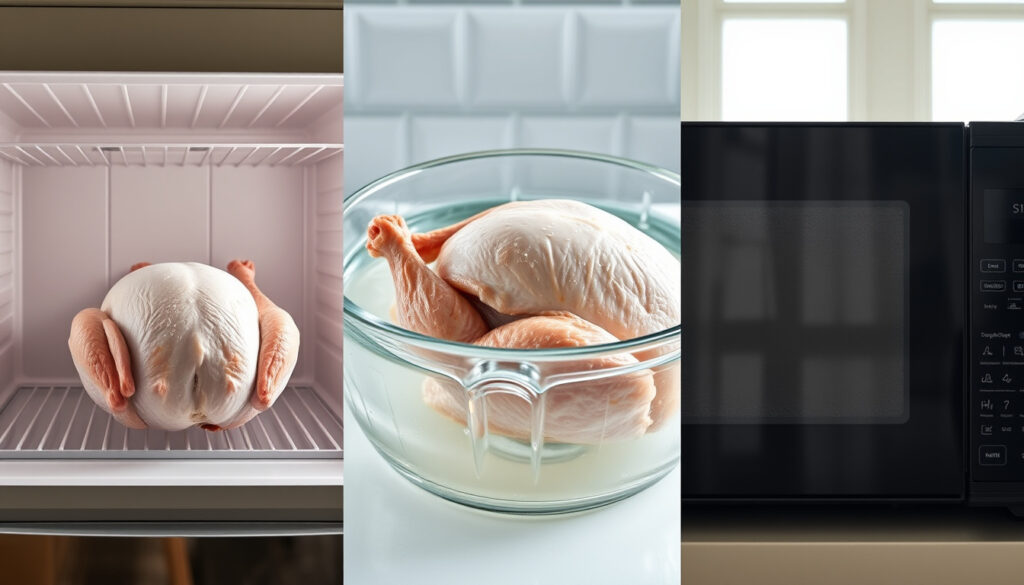
How to Thaw Turkey Safely: Fridge, Water, Microwave
If you’ve ever grabbed a frozen turkey the day before Thanksgiving and wondered whether you can safely rush the process, you’re not alone. Getting the thawing method right matters more than most people realize — the wrong approach can put your holiday meal (and your guests) at risk. Here’s how to thaw turkey safely using the methods backed by USDA food safety guidelines, with times that actually work for real kitchen schedules.
Safe thawing methods: 3 (fridge, cold water, microwave) · Cold water rate: 30 minutes per pound · Fridge rate: 24 hours per 4-5 pounds · Room temp thawing: Unsafe — bacteria risk · Post-thaw fridge life: 1-2 days
Quick snapshot
- Exact thawing times for non-standard weights without a scale
- Regional variations in guidelines — sources apply nationwide
- Cook to 165°F internal temperature in breast, thigh, and wing
- USDA Meat and Poultry Hotline available M-F 10am-6pm ET at 1-888-674-6854 (Cook to 165°F internal temperature in breast, thigh, and wing)
The key facts below summarize USDA-approved guidelines for safe turkey thawing.
| Label | Value |
|---|---|
| Safest method | Refrigerator at 40°F or below |
| Cold water requirement | Leak-proof bag, submerge fully |
| Room temp max | Not recommended over 2 hours |
| Rinse after thaw? | No — spreads bacteria |
| Safe internal temp | 165°F (breast, thigh, wing) |
| Post-thaw fridge storage | 1-2 days before cooking |
| Frozen cooking time | At least 50% longer than thawed |
What is the quickest safest way to thaw a turkey?
USDA identifies three safe ways to thaw turkey: refrigerator, cold water, or microwave oven. Each method works — the choice depends on how much time you have and what you’re willing to manage. The refrigerator is the safest but requires the most planning.
Refrigerator method
Place your turkey in a container to catch any drips, then keep the fridge at 40°F or below. Plan on 24 hours per 4-5 pounds — a 15-pound bird needs roughly 3 days. This is the safest route because the turkey stays at a safe temperature throughout. Once thawed, you have 1-2 days in the fridge before you must cook it.
Cold water method
Put the turkey in a leak-proof bag, submerge it completely in cold tap water, and change the water every 30 minutes. Thawing takes about 30 minutes per pound. A 15-pound turkey needs around 7-8 hours. Unlike refrigerator thawing, you must cook the turkey immediately after cold water thawing — you cannot safely store it.
Microwave method
Not all microwaves handle large birds, so check your manufacturer’s instructions for maximum size. As a guideline, expect roughly 6 minutes per pound on medium power. Cook immediately after microwave thawing — the process actually begins cooking some areas of the meat, and partially cooked turkey cannot be stored safely.
Is it okay to defrost turkey at room temperature?
No. Thawing at room temperature is one of the most common holiday food safety mistakes. The USDA warns that the outer layer enters the Danger Zone — between 40°F and 140°F — while the center may still be frozen. Bacteria multiply most rapidly in this range.
Why room temp is unsafe
When a frozen turkey sits on a counter, the outer surfaces warm first. Even if the center feels solid, those outer layers have already entered the Danger Zone. Once the turkey has been at room temperature for more than 2 hours, it is no longer safe to cook, regardless of how frozen the inside looks.
Bacteria growth risk
Foodborne pathogens like Salmonella and Campylobacter thrive between 40°F and 140°F. The USDA notes that leaving frozen turkey outside monitored areas — whether on a porch, in a garage, or on a counter — puts the bird in this danger zone for bacterial growth before you even start cooking.
The outer layer of a turkey thawing on a counter reaches unsafe temperatures even if the center remains frozen solid. A turkey that looks solid in the middle can still harbor dangerous bacterial levels.
The implication is that a frozen turkey left on the counter for any extended time is not salvageable — it must be discarded, not cooked.
What is the rule for defrosting a turkey?
The core rule: keep the turkey below 40°F at all times during thawing. This means using a refrigerator, cold running water, or a microwave. After thawing by any method other than the refrigerator, you must cook the turkey immediately.
Thawing time guidelines
Refrigerator thawing follows a predictable schedule based on weight. According to University of Nebraska–Lincoln Food (an extension service that mirrors USDA guidelines), turkey thawing times break down as follows:
| Turkey weight | Fridge thawing (days) | Cold water thawing (hours) |
|---|---|---|
| 4-12 lb | 1-3 days | 2-6 hours |
| 12-16 lb | 3-4 days | 6-8 hours |
| 16-20 lb | 4-5 days | 8-10 hours |
| 20-24 lb | 5-6 days | 10-12 hours |
Post-thaw handling
If you thaw in the refrigerator, the turkey can stay there for 1-2 days before cooking. Food thawed in the refrigerator can also be refrozen, though you may notice some quality loss in texture and flavor. For cold water or microwave-thawed turkey, you can refreeze the meat only after cooking it first — never refreeze raw thawed poultry.
Keeping turkey below 40°F is non-negotiable for food safety. The USDA sets this threshold because bacterial growth becomes exponential above it — and holiday meals often feed large groups where foodborne illness spreads quickly.
The pattern here is that refrigerator thawing offers flexibility (1-2 day hold), while cold water and microwave methods trade that flexibility for speed.
What if my turkey is still a little frozen?
If you’re running low on time and the turkey is still partially frozen when you need to cook it, you have options. Partial thawing does not make the turkey unsafe — you just need to adjust your cooking approach.
Partial thaw fixes
If the bird is still firm in spots, submerge it in cold water and change the water every 30 minutes until it gives way. For a partially frozen turkey, you can also finish thawing in cold water for an hour or two, then cook immediately. The key is ensuring the entire bird reaches safe internal temperature at the end of cooking.
Safe cooking options
Cooking from frozen is USDA-approved and perfectly safe — it just takes longer. Plan on at least 50% more cooking time than a fully thawed bird would require. According to UNH Extension, a turkey cooked from frozen takes considerably more time in the oven, but the result is just as safe as one that was thawed first. Just remember: you cannot remove the giblets until the bird has baked for 20-30 minutes, so factor that into your timeline.
A turkey that goes in the oven partially frozen will cook to a safe 165°F — it simply needs more time. If you’re in a pinch, don’t panic. The bird will make it to the table safely.
What this means is that planning mishaps don’t have to ruin your holiday — the USDA built in a cooking-from-frozen option specifically because partial thawing happens to everyone.
What do you do if your turkey isn’t thawing in the fridge?
If your fridge-thawed turkey is behind schedule, switch methods immediately. The worst thing you can do is leave it sitting out to “catch up” — that puts it squarely in the Danger Zone.
Switch to cold water
Cold water is your emergency backup. Seal the turkey in a leak-proof bag, place it in your sink, and run cold tap water over it. Change the water every 30 minutes and keep the turkey fully submerged. This method thaws at 30 minutes per pound, which is significantly faster than the refrigerator. For a 20-pound turkey, you’re looking at roughly 10 hours — manageable overnight if you start in the evening.
Check fridge temp
Before you panic about slow thawing, verify your refrigerator is actually at 40°F or below. If it’s warmer, the thawing process slows down. An inexpensive fridge thermometer is worth the investment during holiday season — it tells you at a glance whether your appliance is performing optimally.
Timeline adjustments
If you’re already past your planned thaw window and switching to cold water, build your schedule around the 30-minutes-per-pound rule. Write down your start time and track water changes. Set phone alarms every 30 minutes to remind yourself to swap the water. Once the turkey is fully pliable with no ice crystals in the cavity, you can cook immediately.
Switching to cold water means you must cook the turkey the same day — you can’t refrigerate it and hold it overnight. If you need more flexibility, cook from frozen instead and add 50% more oven time.
Step-by-Step Thawing Guide
Three paths to a safely thawed turkey, with specific steps for each method.
- Choose your method based on time: Refrigerator (1-6 days advance planning), cold water (hours, same-day cooking required), microwave (minutes, small birds only).
- For refrigerator thawing: Place turkey in a pan or container. Set fridge to 40°F or below. Calculate 24 hours per 4-5 pounds. Check periodically for drips.
- For cold water thawing: Seal bird in leak-proof bag. Submerge in cold tap water. Change water every 30 minutes. Cook immediately after thaw.
- For microwave thawing: Remove original packaging. Place on microwave-safe dish. Use manufacturer’s recommended power level and time (roughly 6 minutes per pound). Cook immediately.
- Verify before cooking: Turkey should feel pliable, not icy. No hard frozen patches in the cavity.
- Cook to safe temperature: Use a food thermometer in the thickest part of the breast, thigh, and wing. Target: 165°F.
Upsides
- Refrigerator method allows 1-2 days flexibility before cooking
- Cold water thaws faster without special equipment
- Microwave handles small birds with no advance planning
- Cooking from frozen is USDA-approved and safe
- Clear temperature benchmarks eliminate guesswork
Downsides
- Refrigerator requires 5-6 days for a 20+ lb bird
- Cold water demands constant attention every 30 minutes
- Microwave impractical for large holiday birds
- Thawing on counter or garage risks foodborne illness
- Cold water and microwave require same-day cooking — no holding
There are three safe ways to thaw food: in the refrigerator, in cold water, and in the microwave oven.
— FSIS USDA (Food Safety Inspection Service)
The outer layer of the food is in the Danger Zone between 40°F and 140°F — a temperature range where foodborne bacteria multiply rapidly.
— USDA Blog (Official Government Publication)
Related reading: Can Dogs Eat Peaches Safety Guide · How to Stop Coughing Fast Remedies
Following USDA guidelines, plan ahead since fridge thawing requires 24 hours per five pounds, while thawing times by weight and method clarify options like cold water immersion.
Frequently asked questions
How long does it take to thaw out a 7 kg turkey?
A 7 kg (roughly 15.5 lb) turkey takes about 3 days in the refrigerator using the 24-hours-per-4-5-pounds rule. In cold water, it needs around 7-8 hours with water changes every 30 minutes.
Should I rinse my turkey after thawing it?
No. Rinsing a turkey — whether thawed or not — can actually spread bacteria around your kitchen via splashing water. USDA guidelines explicitly state that rinsing is unnecessary and potentially hazardous. The cooking process kills any bacteria present.
How to thaw turkey safely overnight?
Overnight thawing only works with the cold water method, not the refrigerator. Place the turkey in a leak-proof bag, submerge it in cold water in your sink, and change the water every 30 minutes. Start by 8pm and you’ll have a thawed bird by morning, ready to cook that day.
How long to defrost 20 lb turkey in fridge?
A 20-pound turkey needs 5-6 days in the refrigerator at 40°F or below. This means a 20-pounder should go in the fridge no later than the Tuesday before Thanksgiving (if cooking Thursday). Cold water thawing takes 10-12 hours for the same size bird.
How to defrost a turkey in water?
Seal the turkey in a leak-proof plastic bag, submerge it completely in cold tap water, and change that water every 30 minutes. The process takes about 30 minutes per pound. Once thawed, cook immediately — you cannot safely refrigerate a cold water-thawed turkey and hold it.
How long to thaw a 20 lb turkey at room temp?
This is not recommended. A 20-pound turkey left at room temperature for more than 2 hours enters the Danger Zone (40°F-140°F), where bacteria multiply rapidly. Even if the center is still frozen, the outer layers are unsafe. Always thaw using refrigerator, cold water, or microwave methods.
Is it safe to thaw a turkey in cold water in the fridge?
This phrasing trips people up — you either thaw in the refrigerator OR in cold water. If you mean “thawing in cold water in the refrigerator’s produce drawer,” that is not the refrigerator method — it’s cold water thawing done inside the fridge. You still must change the water every 30 minutes, and you still must cook immediately after thawing.
For anyone hosting a holiday meal, the stakes are straightforward: a safely thawed turkey means your guests eat well and go home healthy. USDA guidelines exist precisely because foodborne illness from undercooked poultry sends thousands of people to the hospital each year. Following the three approved methods — refrigerator, cold water, or microwave — eliminates that risk almost entirely. If you’re unsure about any step during the process, call the USDA Meat and Poultry Hotline at 1-888-674-6854 (available Monday through Friday, 10am to 6pm Eastern time).
More related posts
 Uncharted (2022): Box Office, Sequel Status & Worth Watching?
 Did Ed Gein Help Catch Ted Bundy? Truth vs Fiction
 Great Dane: Pros, Cons & Lifespan – Is It Right for You
 Jessica Lowndes – Career, Movies, and Personal Life
 Jenna Dewan: Biography, Career, Children, and Relationships
 CPP Payment Dates 2024: Full Schedule & Key Updates
 Secrets Akumal Riviera Maya – Adults-Only Resort Guide
 Alan Cumming: Net Worth, Biography, Traitors Castle