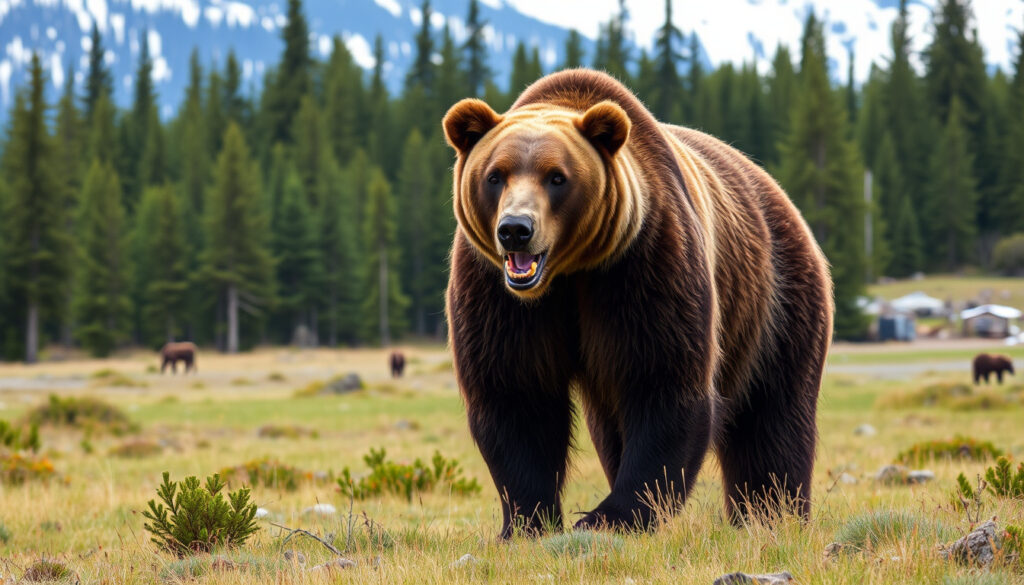
Grizzly Bear: Facts, Aggression, and Safety Tips
You’ve probably seen the footage—a massive brown shape charging across a meadow, and you understand why people give grizzly bears a wide berth. But behind the impressive size and the reputation for aggression lies an animal that is more cautious than confrontational. This guide looks at everything from the origin of the name “grizzly” to the best way to deter an attack, backed by guidance from wildlife officials and researchers.
Average weight (male): 400–790 lbs (180–360 kg) ·
Top speed: 35 mph (56 km/h) ·
Lifespan in wild: 20–25 years ·
Diet: Omnivore (berries, fish, mammals) ·
North American population: ~55,000 ·
Standing height: Up to 8 ft (2.4 m)
Quick snapshot
- Grizzly is a subspecies of brown bear (Ursus arctos horribilis) (U.S. National Park Service).
- Prominent shoulder hump and 2–4 inch claws (U.S. Fish & Wildlife Service).
- Most attacks are defensive, not predatory (NPS).
- Bear spray is the most effective deterrent (Interagency Grizzly Bear Committee).
- Grizzly remains listed as threatened in the lower 48 U.S. states under the Endangered Species Act (FWS).
- No major conservation status changes reported in 2025. (FWS)
- Increased human-wildlife conflict as outdoor recreation grows (Glacier National Park).
- Continued research into non-lethal deterrents and bear behavior. (Glacier National Park)
| Attribute | Value |
|---|---|
| Scientific name | Ursus arctos horribilis |
| Average weight (male) | 400–790 lbs (180–360 kg) |
| Average weight (female) | 290–440 lbs (130–200 kg) |
| Standing height | Up to 8 ft (2.4 m) |
| Top speed | 35 mph (56 km/h) |
| Lifespan in wild | 20–25 years |
Are Grizzly Bears Aggressive?
Grizzly vs. Black Bear Aggression
Grizzly bears are generally more aggressive than black bears when defending food, cubs, or territory, according to the U.S. National Park Service (federal wildlife agency). Black bears are more likely to flee than fight.
Six key differences separate the two species:
| Trait | Grizzly Bear | Black Bear |
|---|---|---|
| Shoulder hump | Prominent (muscle mass) (FWS) | None or slight |
| Face profile | Concave (dished) (NPS) | Straight or convex |
| Claw length | 2–4 inches (IGBC) | Less than 2 inches |
| Aggression level | Higher when threatened (NPS) | Usually flees |
| Typical response to humans | Defensive charge then stop | Climbs tree or runs |
| Color range | Light tan to dark brown | Black, brown, cinnamon, blue-gray |
The implication: knowing whether you’re facing a grizzly or a black bear changes your response strategy—play dead for a grizzly, fight back for a black bear.
Grizzly Bear Threat Displays
Grizzlies communicate aggression through posture. According to Bear Wise Jackson Hole (regional bear safety program), a bear that stands on its hind legs is gathering information, not preparing to attack. A bear that huffs, snaps its jaws, or swats the ground is issuing a warning.
Most encounters end without contact if the human backs away slowly and avoids eye contact. The NPS (federal wildlife managers) emphasizes that running may trigger a chase instinct.
Frequency of Grizzly Attacks
Grizzly attacks are rare relative to the number of people who recreate in bear habitat. The U.S. Fish & Wildlife Service (wildlife conservation agency) reports that most incidents involve a mother protecting cubs or a bear startled at close range. Defensive attacks account for the majority, not predatory behavior.
The pattern: grizzlies are not man-eaters—they react, they don’t hunt.
Why Are Bears Called Grizzly?
Origin of the Name “Grizzly”
The name likely comes from the word “grizzled,” meaning gray-tipped fur, not “grisly” (fearsome). According to the National Park Service, early explorers noted the silver-tipped guard hairs on the bear’s back and shoulders.
Lewis and Clark Expedition
Meriwether Lewis and William Clark first described the bear as “grizly” in their journals after encounters during their 1804–1806 expedition. The NPS notes that the spelling “grizzly” eventually became standard.
Grizzly vs. “Grisly” Confusion
The phrase “grizzly bear” is often misread as “grisly bear” because of the animal’s fearsome reputation. But the etymology is clear: it’s about coat color, not temperament. The scientific name Ursus arctos horribilis (“horrible bear”) was added later by naturalist George Ord, according to FWS.
The trade-off: the scientific name reinforces the scary image, even though the common name is rooted in appearance.
A bear called “horribilis” is actually more interested in berries and salmon than in people. The real danger comes from surprise, not malice.
What Are 10 Facts About Grizzly Bears?
Physical Characteristics
- Grizzlies can weigh up to 800 lbs (360 kg). Males average 400–790 lbs (FWS).
- They stand up to 8 ft (2.4 m) on hind legs (NPS).
- Grizzlies have a prominent hump of muscle on their shoulders for digging (IGBC).
- Their claws are 2–4 inches (5–10 cm) long (FWS).
- They can run up to 35 mph (56 km/h) (NPS).
- They have a keen sense of smell, seven times better than a bloodhound (BearWise).
Diet and Foraging
- Grizzlies are omnivores: berries, fish (especially salmon), small mammals, and carrion (NPS).
- They can eat up to 90 lbs of food per day before hibernation (IGBC).
- Their digging ability helps them unearth roots and rodents (FWS).
Hibernation and Reproduction
- Grizzlies hibernate for 5–7 months in dens (NPS).
- Cubs are born blind and weigh about 1 lb (0.5 kg) (FWS).
- Mature males have a home range of 600–1,000 square miles (IGBC).
- Grizzlies are a keystone species: they disperse seeds and regulate prey populations (NPS).
Which Bear Has Killed the Most Humans?
Statistics on Bear-Related Fatalities
According to NPS data, polar bears are the only bear species that actively hunt humans, but grizzlies cause the most total fatalities in North America due to their defensive nature. Black bears are responsible for the fewest fatal attacks.
Stephen Herrero, author of Bear Attacks: Their Causes and Avoidance, notes: “Polar bears are the only bear species that actively hunt humans, but grizzlies cause the most fatalities in North America due to their defensive nature.”
Polar Bears vs. Grizzlies vs. Black Bears
The table below ranks each bear species by the danger they present to humans and their motivations for attacking.
| Species | Fatalities per encounter | Typical motivation |
|---|---|---|
| Polar bear | Highest (NPS) | Predatory (hunt for food) |
| Grizzly bear | Moderate (most total fatalities) (NPS) | Defensive (startled, threatened) |
| Black bear | Lowest (NPS) | Often predatory when food scarce |
The pattern: grizzly attacks are about protecting space; polar bear attacks are about dinner. That distinction matters for how you respond.
What Part of a Human Does a Bear Eat First?
When a bear does consume a human, it typically starts with the most accessible parts: the head, neck, and chest region, according to forensic analysis referenced by the NPS. This is consistent with how bears feed on any large mammal.
“Polar bears are the only bear species that actively hunt humans, but grizzlies cause the most fatalities in North America due to their defensive nature.”
— Stephen Herrero, author of Bear Attacks: Their Causes and Avoidance
“Grizzlies are not typically aggressive toward humans unless they feel threatened, surprised, or are protecting cubs.”
— National Park Service biologist
What Smell Does a Bear Hate?
Effective Odor Deterrents
Bears are repelled by strong smells like ammonia, bleach, and pine-based cleaners. However, the Interagency Grizzly Bear Committee (bear management authority) warns that homemade deterrents like ammonia-soaked rags have limited and inconsistent effectiveness.
Commercial Bear Sprays
Bear spray containing capsaicin (derived from chili peppers) is the most effective deterrent. The Glacier National Park (NPS unit) calls it “an inexpensive way to deter bear attacks” and notes it has been shown to be the most effective deterrent. A NASA-hosted safety document concludes that proper use of bear spray is superior to firearms for fending off attacks.
The IGBC advises purchasing only EPA-registered bear spray, carrying it in a hip or chest holster, and spraying in a 2- to 3-second burst aimed toward the bear’s face.
Common Household Smells to Avoid
Food odors attract bears. The U.S. Fish & Wildlife Service recommends storing food, garbage, grills, and other attractants in locked hard-sided vehicles or bear-resistant containers.
The trade-off: smelling “bad” to a bear is not the same as being safe—proper storage and distance are the real protections.
A can of bear spray costs around $50 and has a 3-year shelf life. That is much cheaper than a hospital visit—or worse.
Summary
Grizzly bears are not the monsters of legend, but they are powerful animals that demand respect. For anyone heading into grizzly country—whether hiking in Montana, fishing in British Columbia, or camping in Yellowstone—the choice is clear: carry bear spray, travel in groups, and know when to play dead or fight back, or risk an encounter that could turn fatal.
grizzlytimes.org, sabrered.com, hardhattraining.com, nps.gov, facebook.com, yellowstone.org
For a comprehensive overview of grizzly bear behavior and attack prevention, see this detailed guide on grizzly bear facts and safety.
Frequently asked questions
What is the difference between a grizzly and a brown bear?
Grizzly bears are a subspecies of the brown bear (Ursus arctos) found in interior North America. Coastal brown bears are larger due to richer diets. The NPS notes that all grizzlies are brown bears, but not all brown bears are grizzlies.
How fast can a grizzly bear run?
Grizzlies can sprint up to 35 mph (56 km/h), according to the NPS. You cannot outrun one—they are faster than a horse over short distances.
What should you do if you encounter a grizzly?
The NPS advises staying calm, avoiding eye contact, backing away slowly, and never running. If attacked, play dead by lying flat on your stomach with hands clasped behind your neck.
Do grizzly bears climb trees?
Adult grizzlies can climb, but their large claws and weight make them less agile than black bears. Cubs climb readily. The NPS warns that climbing a tree is not a reliable escape from a grizzly.
How long do grizzly bears hibernate?
Grizzlies hibernate for 5 to 7 months, depending on climate and food availability, as reported by the NPS.
Are grizzly bears endangered?
Grizzly bears are listed as threatened in the lower 48 U.S. states under the Endangered Species Act (FWS). Healthy populations exist in Alaska and Canada.
What is the scientific name of the grizzly bear?
The scientific name is Ursus arctos horribilis, as classified by the FWS.
How many grizzly bears are in Yellowstone?
An estimated 600–700 grizzly bears live in the Greater Yellowstone Ecosystem, according to the NPS.
More related posts
 Mena Suvari: Career, Children, and Where She Is Now
 How to Stop Coughing: Fastest Home Remedies & Tips
 Finn Bálor: Nationality, Relationships, and WWE Status
 Robert Trujillo at Ozzy’s Funeral: Career, Net Worth
 Short Track Milano Cortina 2026: Schedule & Key Info
 Troy Aikman: Concussion History, Net Worth, and Relationships
 Largest Desert in the World: Antarctica Beats Sahara by Area
 Can You Vacuum Ants? Survival, Risks, and Better Methods